
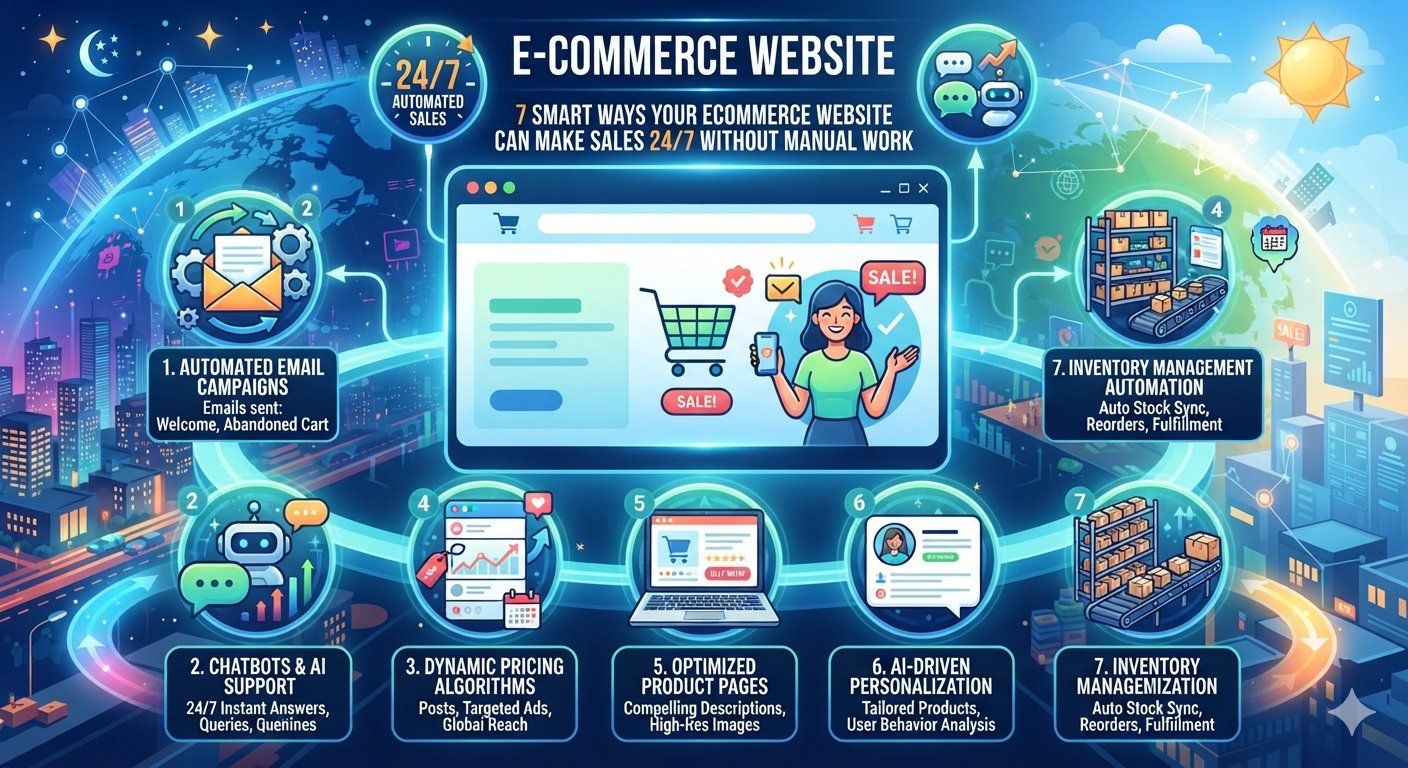


Imagine this: it is 2 AM, you are fast asleep, and your phone buzzes with a new order notification. A customer found your product, paid for it, and received a confirmation email, all without you doing a single thing. This is not a fantasy. A well-built ecom website can sell around the clock, across time zones, on weekends and on holidays. It never shuts like a physical shop.
But a e-commerce website does not sell 24/7 by magic. It needs the right systems working quietly in the background. In this guide, you will learn 7 smart ways to make your e-commerce website earn sales 24/7 without constant manual work.
Table of Contents
Why 24/7 Selling Matters for an Ecom Website
Online shoppers do not follow shop timings. Some browse during lunch breaks, many shop late at night, and others live in different countries with very different time zones. When they are ready to buy, and the store of your’s not able to respond, they simply move to a competitor.
Selling around the clock gives you three clear benefits:
- More sales opportunities. Whenever any buyer will be ready to buy stuff.
- Less manual work. Automation handles repeated tasks, so you can focus on products and growth.
- Better customer experience. Fast replies, instant confirmations and smooth checkout build trust.
Lets have fundamental knowledge to build store.
1. Start with Reliable Hosting and Strong Uptime
Every single thing will be possible only if your store is online. If your site goes down at night, you lose sales without even knowing it. Your hosting is the foundation of any e-commerce website. When you choose a hosting provider, look for:
- High uptime. Aim for a provider that guarantees uptime of 99.9% or more.
- Fast servers. Slow servers frustrate shoppers and push them away before they buy.
- Strong security. An SSL certificate (the padlock in the browser) is essential, because customers will not enter payment details on an unsecured site.
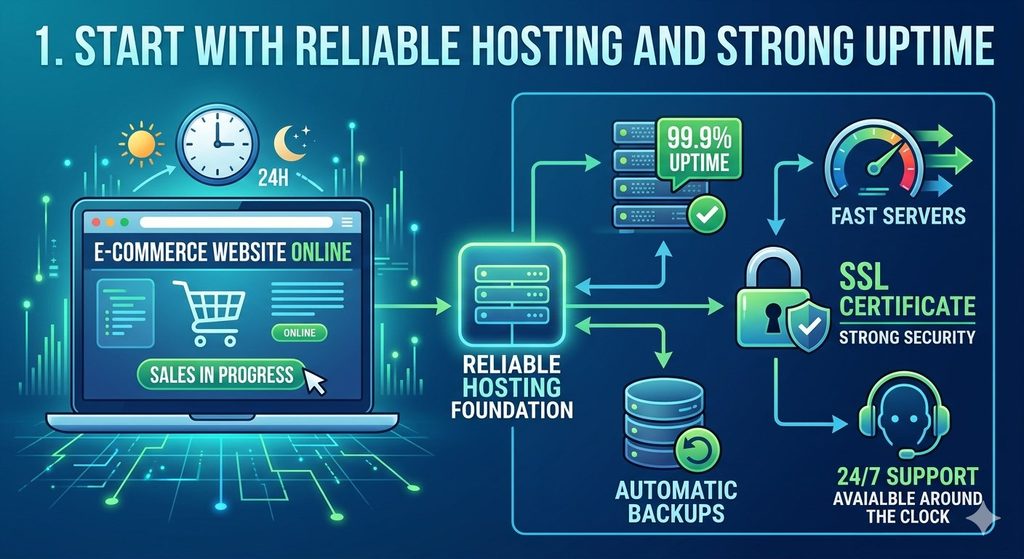
- Backups. Automatic daily backups protect your store if something goes wrong.
- Support that is available around the clock.
A cheap or unreliable host may look like a saving, but one night of downtime during a sale can cost more than a year of hosting. If the doors are locked, nothing else matters.
2. Make Your Website Fast and Mobile-Friendly
Most online shoppers use their phones. If your pages load slowly or look broken on a small screen, visitors leave, and they do it quietly. No lost sales will be able to see. Here is how to keep your store quick and easy to use:
- Compress your images. Large product photos are the most common cause of slow pages. Resize them and use modern formats before uploading.
- Use caching. Caching saves a ready copy of your pages, so they load faster for returning visitors.
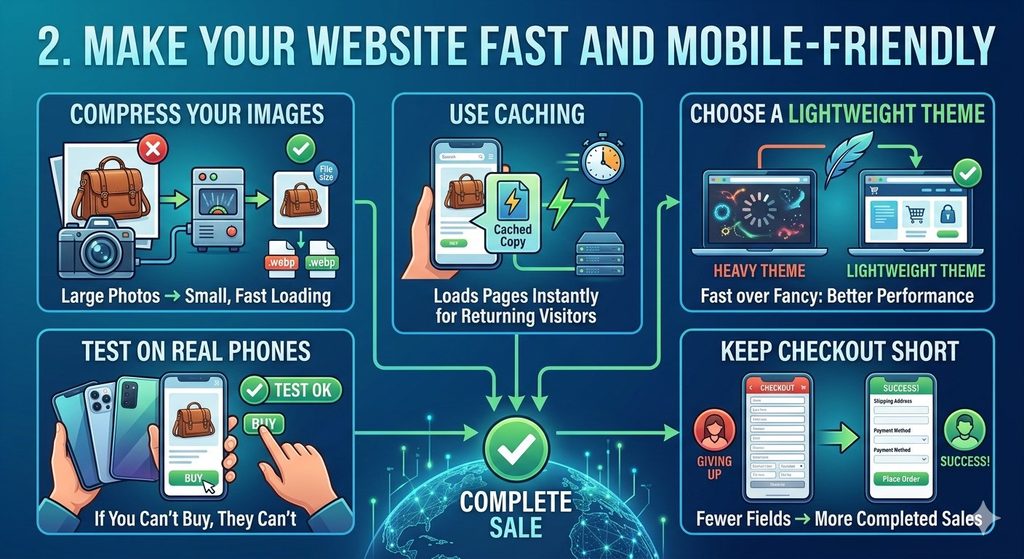
- Choose a lightweight theme. Heavy themes with many animations slow everything down.
- Test on real phones. Open your store on any mobile to experience the working if you face any issues, the customers will surely get to face the same.
- Keep checkout short. Ask only for the details you truly need. Every extra form field makes some customers give up.
A fast, simple store sells itself, because nothing stops the customer from buying.
3. Automate Payments and Order Processing
If you have to confirm every order by hand, your store cannot truly sell 24/7. If buyers want to purchase and pay, get confirmation at the spot. Set up an online payment gateway that supports the methods your customers already use. For customers in India, this usually means UPI, debit and credit cards, net banking and popular wallets. Offering a variety of payment options helps more shoppers complete their purchase from ecom website.
Once a payment is made, your system should handle the next steps automatically:
- Mark the order as paid
- Reduce the stock count
- Send an order confirmation to the customer
- Create an invoice
- Notify you or your packing team
Most ecom platforms, such as WooCommerce, Shopify and others, include these features or offer plugins for them. The goal is simple: from the moment a customer clicks “Pay,” no one has to type anything by hand.
4. Use Automated Emails and Messages from E-Commerce Website
Email is one of the best tools for selling when you are not around. A few well-planned automatic emails can bring back customers and increase your sales while you sleep.
Set up these key automated messages:
- Order confirmation. This reassures the customer immediately and reduces “Did my order go through?” questions.
- Shipping updates. Send the tracking details automatically when an order is dispatched.
- Abandoned cart reminders. Sometimes buyers add stuff to cart and leave or forgot. A friendly reminder email a few hours later can bring some of them back to finish the purchase.
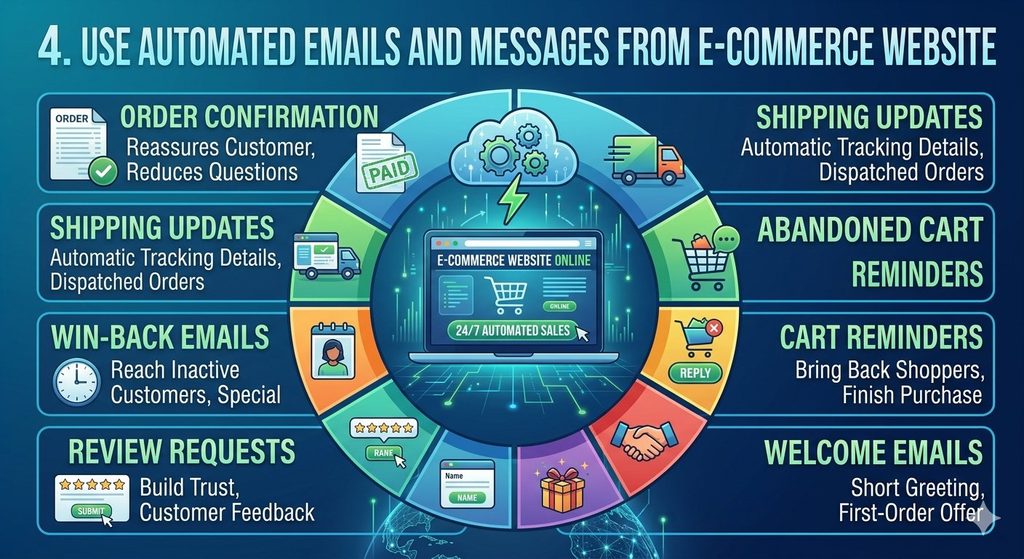
- Welcome emails. When someone signs up, send a short welcome message, and consider a small first-order offer.
- Review requests. Ask for review after delivery. Reviews build trust for future shoppers.
- Win-back emails. Reach out to customers who have not bought for a while with a helpful reminder or offer.
You write these messages once. After that, your e-commerce website sends them at the right time to the right person, with no manual effort.
5. Add Chatbots and Self-Service Help on Ecom Website
Customers often have questions at odd hours. “Do you ship to my city?” “How long does delivery take?” “What is your return policy?”. You can solve this in two ways by adding on your ecom website:
- Build a clear FAQ page. Cover shipping, returns, payments, sizes and order tracking. Place links to it in your menu and on your product pages. A good FAQ reduces the number of repeated questions.
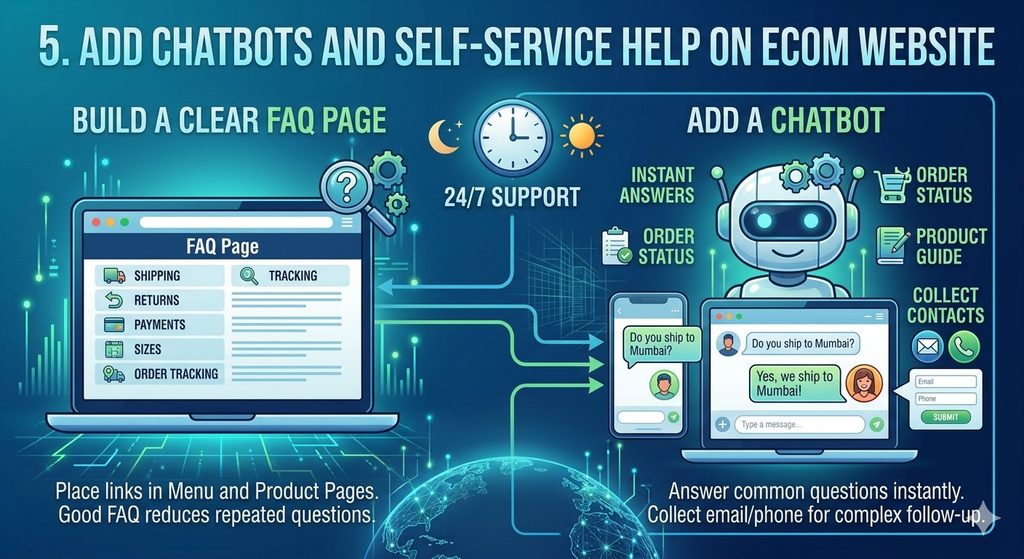
- Add a chatbot. A basic chatbot can answer common questions instantly, share order status and guide visitors to the right product. It can also collect the customer’s email or phone number, so you can follow up in the morning for complex questions.
A chatbot will not replace human support completely, and it is better to be honest about that for your ecom website. But for simple, repeated questions, it keeps customers engaged at any hour and saves you a lot of time.
6. Automate Inventory and Fulfillment
A store that sells 24/7 also needs to deliver reliably. Nothing damages trust faster than selling a product that is out of stock. Here are ways to make the back end run smoothly from your ecom website:
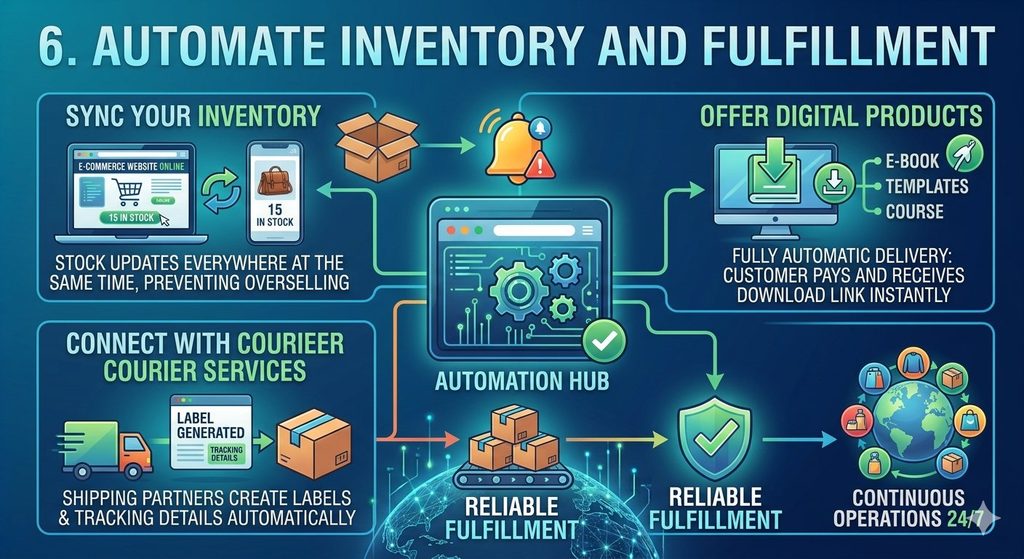
- Sync your inventory. If you sell on your ecom website and other platforms, connect them so stock updates everywhere at the same time. This prevents overselling.
- Set low-stock alerts. Get an automatic notification when a product is running low, so you can reorder in time.
- Offer digital products. If you sell e-books, templates, courses or software, delivery can be fully automatic. The customer pays and receives a download link instantly, which makes it one of the most hands-off models.
- Consider dropshipping or print-on-demand. In these models, a supplier stores and ships the product for you. The order passes to the supplier automatically. Margins can be lower and supplier quality varies, so research carefully before you choose a partner.
- Connect with courier services. Many shipping partners integrate with e-commerce website and platforms, so labels and tracking details can be created automatically.
The less your team has to copy and paste between systems, the fewer mistakes happen, and the easier it is to handle more orders.
7. Bring in Visitors Automatically with SEO and Scheduled Marketing
An automated store still needs visitors. The good news is that some marketing methods keep bringing people in long after you set them up.
- Search engine optimization (SEO). Write clear product titles and descriptions, use relevant keywords, and add helpful content such as buying guides and how-to articles. A well-optimized ecom website can attract visitors from search engines day and night. SEO takes time, but the results can last.
- Blog content. A useful article can keep sending visitors to your store for months or years after you publish it.
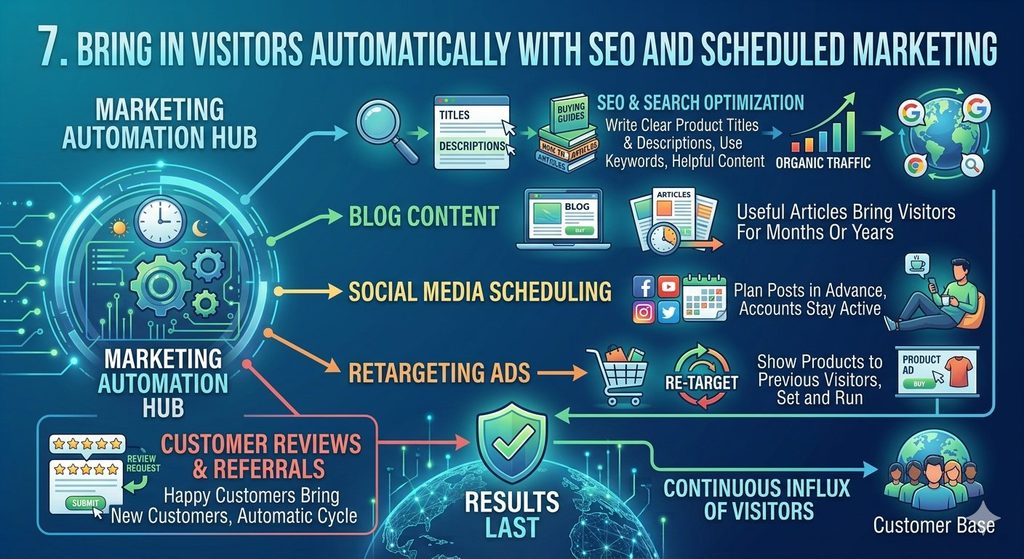
- Social media scheduling. Use scheduling tools to plan posts in advance, so your social accounts stay active even on busy days.
- Retargeting ads. These ads show your products to people who already visited your store. They run automatically once you set them up for your ecom website.
- Customer reviews and referrals. Happy customers bring new customers. An automatic review request and a simple referral offer keep this cycle going.
Together, these methods bring a steady flow of potential buyers to your store without daily manual work.
A Realistic Note: Automation Is Not “Zero Effort”
It is important to be honest here. “Without manual work” does not mean you can set up your store and never look at it again. Even the best automated store needs regular attention. Plan to check these things on a regular schedule:
- Are orders being processed correctly?
- Is the ecom website loading quickly, and is it online?
- Are your automated emails still working and making sense?
- Are there customer complaints or questions the system cannot answer?
- Are your products, prices and stock information up to date?
The goal of automation is to remove repeated, boring tasks, not to remove your attention. Spend your saved time on improving products, studying customer feedback and growing your business on your ecom website.
Quick Checklist to Get Started
If you are not sure where to begin, follow this simple order:
- Choose reliable hosting with strong uptime and an SSL certificate.
- Make your ecom website fast and mobile-friendly.
- Set up automatic payments and order confirmations.
- Create your key automated emails, starting with order confirmation and abandoned cart reminders.
- Add an FAQ page and, if possible, a chatbot on your ecom website.
- Connect inventory and shipping to reduce manual updates.
- Start SEO and scheduled marketing to bring in steady visitors.
You do not need to do everything in one week. Start with the first few steps, and add the others as your store grows.
Conclusion
A successful ecom website does not depend on you being online all the time. With reliable hosting, a fast and simple store, automated payments and emails, helpful self-service support, smooth inventory and fulfillment, and steady marketing, your store can sell 24/7 while you focus on the work that matters most. Remember that every strong automated store starts with a solid foundation. If your ecom website is slow or often offline, no amount of automation can fix it. Begin with dependable hosting, then build each system step by step, and your store will be ready to welcome customers at any hour of the day or night.
Leave a Reply