
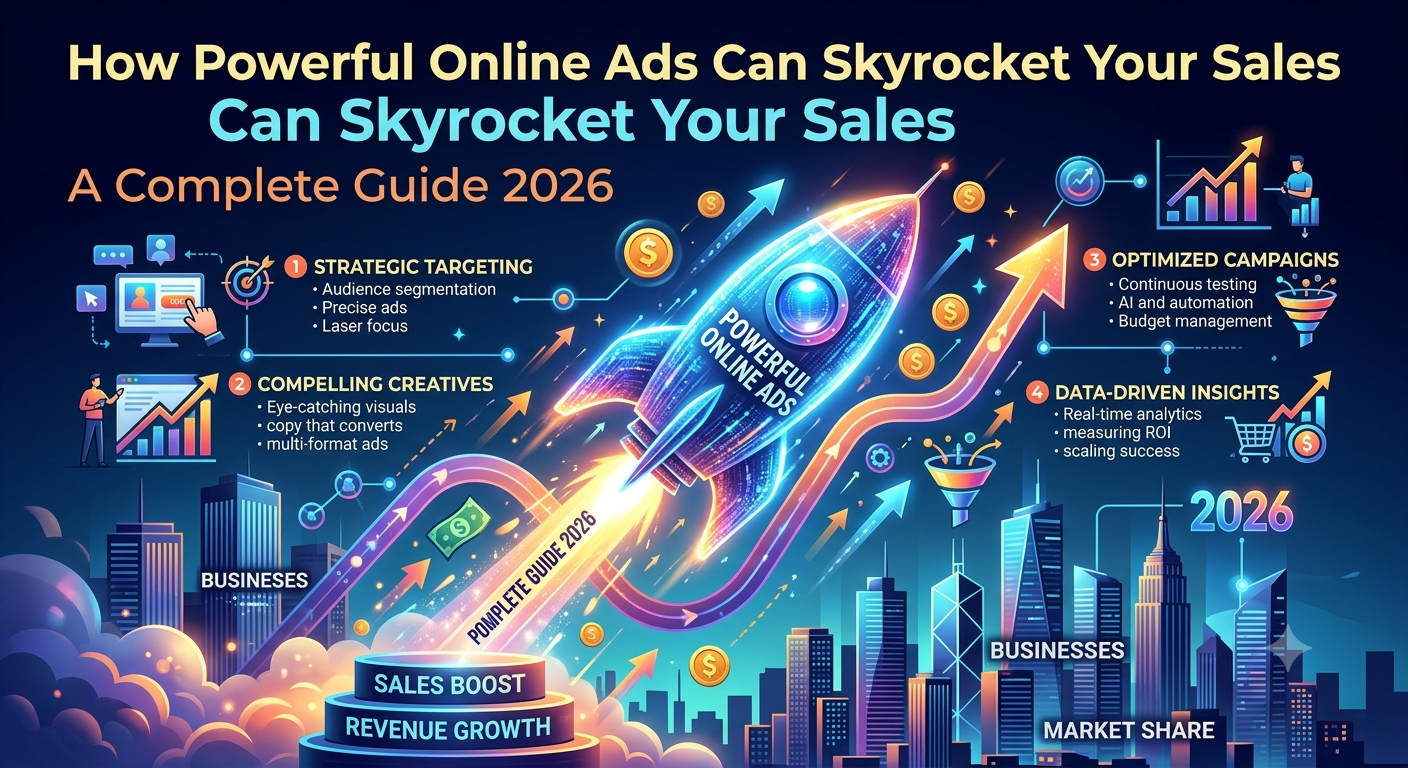


In today’s competitive digital marketplace, attracting customers requires more than simply having a website or social media presence.
Online ads allow businesses of all sizes to promote their products and services to highly targeted audiences, generate leads, increase website traffic, and ultimately drive more sales. Whether you run a small local business, an e-commerce store, or a growing company, a well-planned advertising strategy can help you reach potential customers faster.
But how exactly do online ads increase sales? And how can you create campaigns that deliver meaningful results?
Let’s explore everything you need to know.
Table of Contents
What Are Online Ads?

Online ads are paid promotional messages displayed across digital platforms such as search engines, websites, social media networks, mobile applications, and video platforms.
Common forms of online advertising include:
- Search ads: Appear when people search for relevant keywords on search engines.
- Social media ads: Displayed on platforms such as Facebook, Instagram, LinkedIn, and other social networks.
- Display ads: Visual advertisements shown on websites and apps.
- Video ads: Promotional videos displayed before, during, or alongside online video content.
- Shopping ads: Product-focused advertisements that showcase images, prices, and other details.
- Remarketing ads: Ads designed to reconnect with people who have previously visited your website or interacted with your business.
Each advertising format serves a different purpose. Choosing the right combination depends on your target audience, business goals, budget, and industry.
How Online Ads Can Increase Your Sales
1. Reach Your Ideal Customers
One of the biggest advantages of online advertising is precise audience targeting.
Traditional advertising can make it difficult to know exactly who sees your message. Online advertising platforms, however, provide targeting options that can help businesses reach audiences based on factors such as location, interests, search behavior, demographics, and previous interactions.
For example, a local fitness studio may target people within a specific geographic area who are interested in fitness and wellness.
By presenting your offer to people who are more likely to need your product or service, you can make your advertising budget more efficient.
2. Increase Brand Visibility
Customers often need multiple interactions with a brand before making a purchase decision.
Online ads can consistently put your business in front of potential customers while they browse websites, search for products, watch videos, or use social media.
Even when someone does not immediately click your advertisement, repeated exposure can help increase awareness of your brand.
Strong visibility can be especially valuable for newer businesses competing against established companies.
3. Drive Targeted Website Traffic
Getting visitors to your website is important, but attracting the right visitors is even more valuable.
Online advertising can direct users toward specific landing pages, product pages, service pages, or contact forms.
For example, instead of sending every visitor to your homepage, you could create an advertisement specifically for a particular product and direct users straight to that product’s page.
This creates a more relevant customer journey and can make it easier for visitors to take action.
4. Generate High-Quality Leads
Online advertising is not limited to direct product sales.
A lead could be someone who:
- Completes a contact form
- Requests a quote
- Downloads an e-book
- Signs up for a webinar
- Books a consultation
- Subscribes to an email list
- Calls your business
For service-based companies, lead generation can be an important step toward future sales.
A well-designed advertisement combined with a compelling landing page can encourage potential customers to provide their information and begin a relationship with your business.
5. Retarget Potential Customers
Not everyone who visits your website will purchase something immediately.
Some visitors may browse your products, compare prices, or leave because they are not ready to buy.
Remarketing allows businesses to reconnect with eligible previous visitors or customers through advertising platforms that support these campaigns.
For example, someone may view a pair of shoes on an online store but leave without purchasing. A later advertisement can remind that person about the product or introduce a related offer.
This can help bring interested prospects back into the purchasing journey.
6. Create Personalized Advertising Experiences
Relevant advertising can be more effective than generic messaging.
Instead of presenting the same advertisement to everyone, businesses can develop different campaigns for different audience segments.
For example:
- New visitors can receive an introduction to your brand.
- Returning visitors can see popular products.
- Existing customers can receive information about complementary products.
- Local customers can see location-specific offers.
Personalization can make advertisements more relevant and help customers find information that matches their needs.
How to Create Online Ads That Convert

Running advertisements does not automatically guarantee more sales. Your campaign needs a clear strategy.
Define a Specific Goal
Your goal could be:
- Increasing product sales
- Generating leads
- Getting phone calls
- Increasing website traffic
- Promoting a new product
- Growing brand awareness
- Increasing registrations
A specific objective makes it easier to choose the right advertising format and measure performance.
Know Your Target Audience
Successful advertising starts with understanding your customers.
Consider:
- Who are they?
- What problem are they trying to solve?
- What motivates them to buy?
- What objections might prevent a purchase?
- Where do they spend time online?
The more clearly you understand your audience, the more relevant your advertisements can become.
Write a Powerful Ad Copy
Below is a sample image of a good adcopy:

Your advertisement needs to capture attention quickly.
A strong ad generally communicates:
- The problem or need
- The solution
- The benefit
- A clear call to action
Use a Strong Call to Action
Tell people exactly what you want them to do next.
Examples include:
- Shop Now
- Get a Free Quote
- Book a Consultation
- Learn More
- Start Today
- Request a Demo
- Download the Guide
A clear call to action can reduce uncertainty and make the next step obvious.
Create a Relevant Landing Page
An advertisement is only one part of the customer journey.
If your ad promotes a specific product, the landing page should make it easy to learn about and purchase that product.
Keep the page focused, mobile-friendly, fast, and easy to navigate.
Your landing page should clearly communicate:
- What you offer
- Why it matters
- Key benefits
- Pricing or relevant details
- Trust signals
- How customers can take the next step
Measure Your Advertising Performance
One of the biggest advantages of digital advertising is the ability to track results.
Important metrics may include:
Click-Through Rate (CTR)
CTR measures the percentage of people who click your advertisement after seeing it.
A higher CTR can indicate that your ad is relevant and compelling to the audience, although CTR should always be considered alongside other metrics.
Conversion Rate
Conversion rate measures how many visitors complete a desired action, such as making a purchase or submitting a form.
This helps you understand whether your traffic is producing meaningful results.
Cost Per Click (CPC)
CPC shows how much you pay, on average, for each click.
Monitoring CPC can help you understand how efficiently your advertising budget is generating traffic.
Return on Ad Spend (ROAS)
ROAS compares revenue attributed to advertising with advertising expenditure.
For businesses focused on direct sales, this can be an important metric for evaluating campaign performance.
Cost Per Acquisition (CPA)
CPA measures the average advertising cost associated with acquiring a customer or completing a specified conversion.
Tracking these metrics can help you identify which campaigns, audiences, and advertisements are producing useful results.
Tips for Maximizing Your Online Advertising Results
Test Different Ad Variations
Avoid assuming that your first advertisement will be your best advertisement.
Test different:
- Headlines
- Images
- Videos
- Offers
- Calls to action
- Audience segments
- Landing pages
Small improvements can make a meaningful difference over time.
Optimize for Mobile Users
A significant amount of online activity takes place on mobile devices.
Make sure your advertisements and landing pages look professional and function properly on smartphones and tablets.
Use readable text, clear buttons, fast-loading pages, and simple navigation.
Start With a Controlled Budget
You do not necessarily need a huge advertising budget to begin.
Start with a controlled amount, monitor performance, and identify what works. You can then gradually increase spending on campaigns that meet your business objectives.
Focus on Value, Not Just Promotion
People do not want to feel like they are constantly being sold to.
Your advertisements should communicate why your product or service is valuable.
Highlight benefits, solve problems, answer common questions, and show customers what makes your offering useful.
Common Online Advertising Mistakes to Avoid
Businesses can waste advertising budgets when campaigns are launched without proper planning.
Common mistakes include:
- Targeting an overly broad audience
- Using unclear ad copy
- Sending users to irrelevant landing pages
- Ignoring mobile optimization
- Failing to track conversions
- Making decisions based on too little data
- Using the same message for every audience
- Focusing only on clicks instead of meaningful business outcomes
Avoiding these mistakes can help you build a more focused and measurable advertising strategy.
The Future of Online Advertising
Online advertising continues to evolve as customer behavior, technology, and digital platforms change.
Businesses increasingly have access to sophisticated targeting, automation, analytics, creative tools, and customer data.
However, technology alone does not create successful advertising.
The fundamentals remain important: understand your customers, provide genuine value, communicate clearly, test your approach, and measure meaningful results.
Businesses that combine creativity with data-driven decision-making can build advertising campaigns that support long-term growth.
Conclusion
Online advertising can provide businesses with a powerful way to increase visibility, attract targeted visitors, generate leads, and drive sales.
The key is not simply to spend more money on advertisements. Instead, focus on reaching the right audience with the right message and guiding them toward a clear action.
Start by defining your goal, understanding your customers, selecting suitable advertising platforms, creating compelling advertisements, optimizing your landing pages, and tracking important performance metrics.
With consistent testing and optimization, online ads can become an important part of a sustainable digital marketing strategy and help your business unlock new opportunities for growth.
FAQs
Q. Can online ads really increase sales?
A. Yes. Online ads can help increase sales by reaching targeted audiences, driving relevant traffic, promoting products or services, generating leads, and encouraging customers to take action. Results depend on factors such as targeting, advertising quality, offer, landing page experience, competition, and budget.
Q. How much should a business spend on online advertising?
A. There is no universal advertising budget that works for every business. Your budget can depend on your industry, goals, audience size, product margins, competition, and expected customer value. Starting with a controlled budget and measuring results can help you determine an appropriate level of investment.
Q. Which online advertising platform is best for sales?
A. There is no single platform that is best for every business. Search advertising can be useful for reaching people actively looking for specific products or services, while social advertising can help businesses reach audiences based on available targeting options and engagement behavior. The right platform depends on your customers and objectives.
Q. How long does it take for online ads to generate sales?
A. The timeframe varies considerably. Some campaigns may generate conversions quickly, while others require testing, optimization, and repeated exposure. Factors such as the product, buying cycle, audience, offer, competition, and campaign setup can all affect results.
Q. What makes an online ad successful?
A. A successful online advertisement typically has a clearly defined audience, relevant messaging, a compelling value proposition, strong creative, and a clear call to action. It should also lead to a relevant and user-friendly landing page.
Q. Should small businesses use online advertising?
A. Online advertising can be useful for businesses of different sizes, including small businesses. It allows businesses to start with controlled budgets, reach specific audiences, and measure campaign activity. Small businesses should align advertising spending with their goals and track results carefully.
Q. What is remarketing in online advertising?
A. Remarketing is an advertising approach that allows businesses to reach eligible audiences who have previously interacted with their website, app, or other digital content. It can help reconnect with people who showed interest but did not complete a desired action.
Leave a Reply